
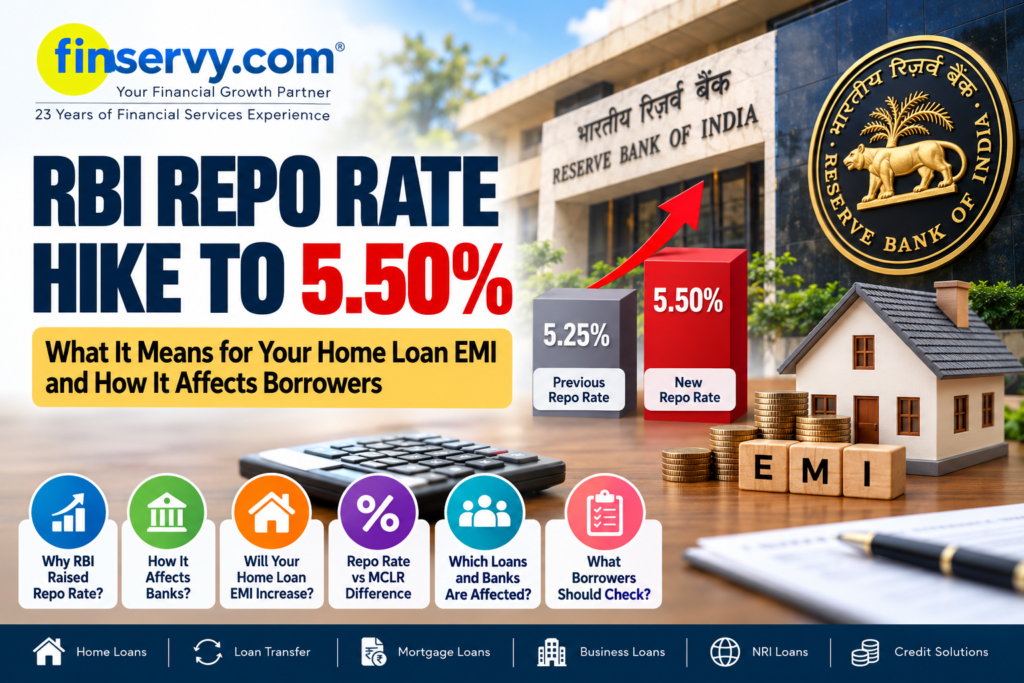
RBI Repo Rate Hike to 5.50%: What It Means for Your Home Loan EMI
Published: October 7, 2026
The Reserve Bank of India (RBI) has increased the Repo Rate by 0.25%, taking it from 5.25% to 5.50%.
If you have a home loan, business loan, loan against property or another floating-rate loan, you may be asking:
“Will my EMI increase?”
The answer is: It depends on your loan.
Not every borrower will see the same impact.
Let’s understand it in simple language.
What Is the RBI Repo Rate?
The Repo Rate is the rate at which the RBI lends money to banks.
Think of it as one of the important starting points for the cost of money in the banking system.
When the RBI increases the Repo Rate, borrowing can become more expensive for banks and, depending on the loan’s benchmark and reset mechanism, this can eventually affect borrowers.
When the RBI reduces the Repo Rate, floating loan rates may come down, depending on the lender and the type of loan.
Why Did RBI Increase the Repo Rate?
This is the big question.
RBI increased the Repo Rate mainly because inflation risks are increasing.
1. Crude Oil Prices Are Rising 🛢️
India imports a large amount of crude oil.
When crude oil becomes expensive, it can increase the cost of:
- Petrol and diesel
- Transport
- Manufacturing
- Logistics
- Everyday goods
This can put pressure on inflation.
Recent geopolitical tensions have also pushed oil prices higher. Reuters
2. Food and Weather Risks 🌾
Weak monsoon conditions and weather-related problems can affect agricultural production.
If food supply is affected, food prices can increase.
This can add to inflation pressure.
3. RBI Wants to Control Inflation
The RBI’s main job is not just to make loans cheaper.
It also has to maintain price stability.
If prices start rising too quickly, RBI can use interest rates to cool demand and control inflation.
4. India’s Economy Is Still Growing
Interestingly, RBI is not raising rates because the economy has collapsed.
India’s economic growth remains strong, with RBI’s FY2026-27 growth forecast raised to 7.1%. Reuters
So RBI has some room to focus more on inflation control.
How Does a Repo Rate Hike Affect Borrowers?
This is where things get interesting.
A Repo Rate increase does not automatically mean everyone’s EMI will increase tomorrow.
Your loan’s benchmark and reset terms matter.
You may have a loan linked to:
- Repo Rate / External Benchmark
- EBLR
- RLLR
- MCLR
- Fixed interest rate
Let’s understand the difference.
Repo Rate vs MCLR: What’s the Difference?
This is one of the most important things borrowers should understand.
| Repo / External Benchmark | MCLR |
|---|---|
| Linked to an external benchmark | Based on the bank’s internal cost of funds and other factors |
| Repo Rate is decided by RBI | MCLR is calculated/reviewed by the bank |
| Changes in RBI Repo Rate can directly affect the benchmark | Repo-rate change does not automatically mean MCLR changes immediately |
| Reset happens according to loan terms | MCLR loans have their own reset period |
| Common for newer applicable floating-rate retail loans | Commonly seen in older floating-rate loans |
RBI’s current framework requires banks to link floating-rate retail and MSME loans to an external benchmark, which can include the RBI Repo Rate. MCLR continues to be relevant for loans that are contractually linked to it. Reserve Bank of India
In very simple words:
Repo-linked loan:
RBI increases Repo Rate
↓
External benchmark can increase
↓
Your loan rate may increase at the applicable reset
↓
EMI or tenure may change
MCLR-linked loan:
RBI increases Repo Rate
↓
Bank’s MCLR may change depending on its costs and review
↓
Your loan rate changes according to your MCLR reset terms
So, Repo Rate hike ≠ automatic EMI hike for everyone.
What Are EBLR and RLLR?
Don’t let these banking abbreviations scare you. 😄
EBLR
External Benchmark Linked Lending Rate
The bank links your floating loan to an external benchmark.
For many applicable retail loans, the RBI Repo Rate is used as the external benchmark.
RLLR
Repo Linked Lending Rate
It means the lending rate is linked to the Repo Rate.
A simplified example could look like:
Repo Rate + Bank’s Spread = Lending Rate
So when the Repo Rate changes, the benchmark component can change.
But your final interest rate also depends on the bank’s applicable spread and your loan terms.
Which Bank Loans Can Be Affected?
Borrowers from major banks such as:
- SBI
- Bank of Baroda
- PNB
- Canara Bank
- Union Bank
- Bank of India
- HDFC Bank
- ICICI Bank
- Axis Bank
- Kotak Mahindra Bank
and other lenders should check how their particular loan is benchmarked.
The important point is:
Don’t ask only:
“Which bank increased its interest rate?”
Ask:
“What benchmark is my loan linked to?”
The same bank can have different products, loan structures and reset terms.
Will Your Home Loan EMI Increase?
Maybe.
It depends on:
Your current interest rate
Your loan benchmark
Your bank’s spread
Your reset date
Your outstanding loan amount
Your remaining tenure
For some borrowers, the lender may increase the EMI.
For others, the lender may increase the loan tenure.
In some cases, both may change.
Example: Why Tenure Is Important
Imagine you have a long-term home loan.
Your EMI doesn’t increase much after an interest-rate change.
You may think:
“Great, no problem.”
But check the tenure.
If your loan period increases, you may end up paying interest for more months.
That is why borrowers should not look at EMI alone.
Always check:
Interest Rate + EMI + Remaining Tenure + Total Interest
What Should Existing Borrowers Check Now?
After today’s RBI Repo Rate hike, take 10 minutes and check your loan statement.
1. Current Interest Rate
What interest rate are you paying today?
2. Loan Benchmark
Is your loan linked to:
Repo / EBLR / RLLR / MCLR / Fixed Rate?
3. Outstanding Loan
How much principal is still pending?
4. EMI
Has your EMI changed?
5. Remaining Tenure
How many months or years are left?
6. Reset Date
When will your loan interest rate be reviewed?
7. Bank Spread
What spread is your bank charging over the applicable benchmark?
These details will tell you the real impact of the RBI rate hike on your loan.
What If You Are Planning to Take a Home Loan?
Don’t make your decision based only on today’s interest rate.
Before taking a home loan, calculate:
Property price
→ Down payment
→ Loan amount
→ EMI
→ Interest rate
→ Total interest
→ Your monthly income
→ Existing EMIs
Also ask yourself:
“If my interest rate increases by another 1%, can I still comfortably pay my EMI?”
This is a simple but powerful stress test.
Should You Transfer Your Home Loan?
If you have an old home loan with a relatively high interest rate, you can explore a Home Loan Balance Transfer.
But don’t transfer your loan just because another bank advertises a lower rate.
Compare:
- Existing interest rate
- New interest rate
- Outstanding loan
- Remaining tenure
- Processing fee
- Legal/technical charges
- Other applicable costs
- Total expected savings
The goal is not a lower rate.
The goal is actual savings.
Should You Prepay Your Home Loan?
A rate hike doesn’t automatically mean you should empty your savings and prepay your loan.
Before making a prepayment, consider:
- Emergency fund
- Family expenses
- Existing liabilities
- Loan interest rate
- Outstanding principal
- Remaining tenure
- Your future financial needs
A partial prepayment can reduce the principal and future interest, but you should maintain sufficient liquidity.
What About New Borrowers?
If you are planning to buy a house, don’t panic.
Instead, borrow responsibly.
Remember the 4 numbers:
Property Price
Down Payment
Loan Amount
Comfortable EMI
Don’t buy a property based on the maximum loan amount a bank is willing to give you.
Choose a loan amount that your monthly income can comfortably support.
The 5-Minute Borrower Check
If you already have a loan, check these 5 things today:
✅ 1. What is my interest rate?
✅ 2. What is my benchmark?
✅ 3. When is my next reset?
✅ 4. How much principal is still outstanding?
✅ 5. Has my EMI or tenure changed?
That’s enough to start.
RBI Repo Rate Hike: The Simple Flow
RBI increases Repo Rate
⬇️
External benchmark may increase
⬇️
Applicable floating loan rates may increase
⬇️
EMI or loan tenure may increase
⬇️
Borrower’s total interest cost may increase
But remember:
This is not automatic for every borrower.
Your loan terms decide the actual impact.
Final Takeaway
The RBI has increased the Repo Rate from 5.25% to 5.50% by 25 basis points.
The main reason is rising inflation risk, particularly from higher oil prices, weather-related supply concerns and global uncertainty. At the same time, India’s economic growth remains strong. Reuters
For borrowers, the most important thing is not to panic.
Instead, understand your loan.
Check your:
Interest Rate → Benchmark → Spread → Reset Date → EMI → Outstanding Loan → Remaining Tenure
And remember:
RBI Repo Rate increase does not automatically mean every borrower’s EMI will increase immediately.
Your loan structure matters.
Understand your loan before your loan becomes a burden.
Finservy.com

23 Years of Financial Services Experience
Home Loans | Loan Transfer | Mortgage Loans | Business Loans | NRI Loans | Credit Solutions