
Bank Strikes in India: Why Are Bank Employees Protesting and What Are Their Demands?
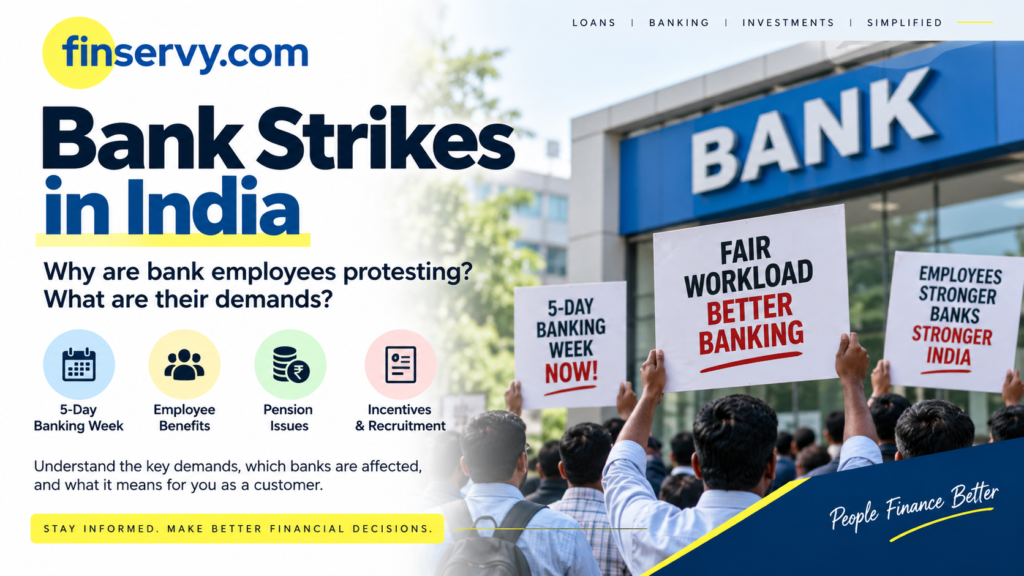
Bank strikes in India have once again brought attention to an important question: Why are bank employees going on strike, and what exactly are they demanding?
The recent nationwide strike was called by the United Forum of Bank Unions (UFBU), an umbrella organisation representing major bank employee and officer unions. The immediate focus of the protest is the long-pending demand for a five-day banking week, along with several employee, pension and incentive-related issues.
What is the main demand?
1. Five-day banking week
The biggest demand is to make Monday to Friday the regular banking workweek, with all Saturdays declared holidays.
At present, banks generally remain closed on the second and fourth Saturdays, while other Saturdays can be working days.
Bank unions argue that the five-day week has already been agreed upon in principle through the 12th Bipartite Settlement/9th Joint Note signed in March 2024.
Under the proposed arrangement, employees would work additional hours from Monday to Friday to compensate for the additional weekly holiday. The unions say the proposal was subsequently recommended to the government but has not yet been implemented.
2. Changes to the Performance-Linked Incentive (PLI) system
Another major issue concerns the Performance-Linked Incentive (PLI) system.
Bank unions have objected to the revised structure, arguing that it creates differences in incentives between different categories of employees and officers.
The unions want the incentive structure to be discussed through bilateral negotiations with the banking industry rather than having a structure they consider discriminatory imposed on employees.
There has been some movement on this issue. The Department of Financial Services reportedly advised public-sector banks to keep the PLI scheme for certain senior officers in abeyance for 2025–26, with the issue to be discussed with the unions and the Indian Banks’ Association.
However, the unions said this alone was not enough to withdraw the strike because their principal demand, the five-day banking week, remained unresolved.
Other demands raised by bank unions
The strike is not only about Saturdays.
UFBU-affiliated unions have also raised several long-pending issues concerning employees and retirees, including:
- Adequate recruitment of clerical and sub-staff employees
- Filling vacant positions in banks
- Pension updation
- Uniform Dearness Allowance (DA) for pensioners
- Resolution of pension-related issues
- A demand for an option to move from NPS to the Old Pension Scheme (OPS)
- Revision of ex-gratia payments for certain retired employees
- Increase in the gratuity ceiling
- Filling employee/officer director positions in banks
- Introduction of a Leave Bank
- Better medical-insurance arrangements for retired bank employees
Why do unions want a five-day banking week?
The unions argue that banking has changed significantly because many services are now available digitally.
Customers can perform many routine transactions through:
- UPI
- Mobile banking
- Internet banking
- ATMs
- Digital account services
The unions therefore argue that a five-day workweek can improve employee work-life balance while weekday working hours can be adjusted to maintain customer service.
However, the implementation still requires the necessary government approval, which is why the issue has remained unresolved.
Which banks are affected by the strikes?
The recent UFBU strike has primarily affected public-sector banks, where participation has been significant. Some old-generation private-sector banks may also be affected depending on union participation.
Major private-sector banks generally continued their operations during the recent strike.
This distinction is important for customers:
A bank strike does not automatically mean every bank in India is closed.
The impact depends on the bank, employee participation and location.
What happens to customers during a bank strike?
Customers may experience delays in services that require physical branch staff, such as:
- Cash deposits and withdrawals at branches
- Cheque-related processing
- Demand drafts
- Certain KYC/documentation activities
- Loan documentation
- Property-document processing
- Other branch-dependent services
Digital services such as UPI, internet banking, mobile banking and ATMs generally continue to operate, although transactions requiring manual or back-office processing may be delayed.
For customers with urgent loan or property transactions, it is therefore sensible to complete branch-dependent work in advance.
Are more bank strikes planned?
The recent September 11 strike is part of a wider escalation announced by UFBU.
According to the announced programme:
September 11, 2026: One-day nationwide strike
September 28–30, 2026: Three-day nationwide strike
From October 26, 2026: An indefinite nationwide strike has been threatened if the issues remain unresolved.
These are union-announced actions, and the situation can change if negotiations produce an agreement.
What does this mean for bank customers?
For most customers, the biggest impact is operational rather than financial.
A bank strike does not mean:
- Your bank account is frozen
- Your loan is cancelled
- Your EMI is automatically changed
- Your UPI stops permanently
- Your bank’s interest rate changes
The main concern is delay in branch-based services.
If you are processing a home loan, business loan, property transaction, cheque, KYC update or other documentation, allow additional time around announced strike dates.
The bigger question: Will India eventually move to five-day banking?
The demand has been under discussion for years, and the 2024 banking settlement gave the proposal additional significance.
But an agreement between banking unions/industry representatives is not the same as a final government notification.
Until the required approval and implementation are completed, customers should continue to follow the existing banking calendar.
Finservy Takeaway
The bank strikes are not simply about getting Saturdays off.
They bring together several broader issues:
Employee work-life balance + staffing shortages + incentive structures + pension concerns + the changing nature of digital banking.
For customers, the practical lesson is simple:
Digital banking may keep running during a strike, but branch-dependent services can be delayed. Plan loan documentation, property transactions and cheque-related work accordingly.
This article is based on publicly reported union statements and current reporting. Strike schedules and negotiations may change if the parties reach an agreement.