
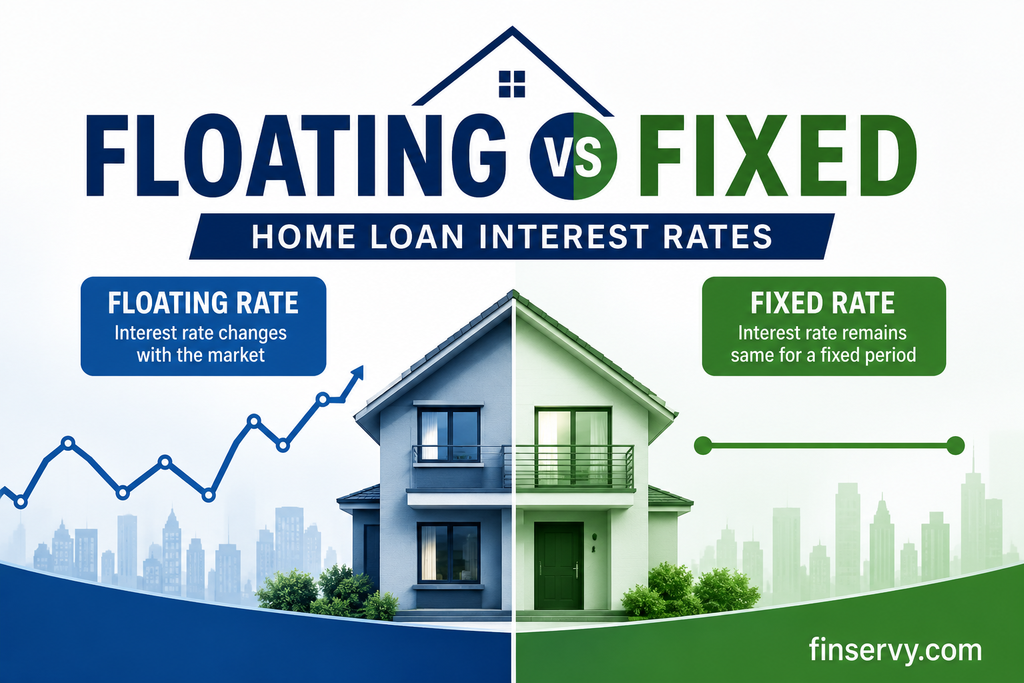
Floating vs Fixed Home Loan Interest Rate: Which Is Better?
When taking a home loan, one important decision is choosing between a floating interest rate and a fixed interest rate.
The choice can affect your EMI, total interest and financial planning for many years. So, before choosing, understand how both options work.
What Is a Floating Home Loan Interest Rate?
A floating interest rate can change during the loan period depending on the benchmark to which your loan is linked.
When the benchmark rate increases, your home loan interest rate may increase. This can result in a higher EMI or a longer loan tenure.
Similarly, when the benchmark rate falls, your interest rate may reduce, depending on the terms of your loan.
Example
Suppose you have a ₹50 lakh home loan.
If your interest rate increases, even by a small percentage, your total interest burden can increase significantly over a long tenure.
That is why borrowers should not look only at today’s interest rate. They should also understand how the rate can change in the future.
What Is a Fixed Home Loan Interest Rate?
With a fixed interest rate, the interest rate remains fixed for the agreed fixed period.
This gives you better certainty about your EMI during that period.
However, there is an important point to remember:
“Fixed” does not always mean fixed for the entire 15 or 20-year loan.
Some lenders may offer a fixed rate only for a particular period and then reset the rate according to the terms of the loan agreement.
RBI itself advises borrowers to check the reset clause carefully, particularly where a loan is described as fixed for only part of its tenure.
Floating vs Fixed: Simple Comparison
| Feature | Floating Rate | Fixed Rate |
|---|---|---|
| Interest rate | Can change | Remains fixed for agreed period |
| EMI | Can increase or decrease | Generally stable during fixed period |
| Budget planning | Less predictable | Easier |
| Benefit if rates fall | Yes | Usually no during fixed period |
| Risk if rates rise | Higher | Lower during fixed period |
| Suitable for | Borrowers comfortable with rate changes | Borrowers wanting more certainty |
What Does RBI Say About Floating Rate Home Loans?
The Reserve Bank of India introduced important safeguards for borrowers with EMI-based floating-rate loans.
At the time of sanction, lenders are required to explain the possible impact of changes in the benchmark rate on the borrower’s EMI and/or loan tenure.
When the interest rate is reset, borrowers should be given options such as:
- Increase the EMI
- Increase the loan tenure
- Choose a combination of higher EMI and longer tenure
- Switch to a fixed interest rate, as per the lender’s Board-approved policy
- Prepay the loan partly or fully, subject to applicable rules and terms
The lender must also transparently disclose applicable charges for switching from floating to fixed.
Can a Floating Home Loan Be Converted to Fixed?
Yes, RBI’s framework provides borrowers an option to switch from a floating rate to a fixed rate at the time of an interest-rate reset, subject to the lender’s Board-approved policy.
The lender’s policy can specify the number of times such a switch is permitted and the applicable charges must be disclosed transparently.
This is an important protection for borrowers because you are not necessarily locked into the floating-rate structure forever.
One Important Point About “Fixed Rate”
Before choosing a fixed-rate home loan, ask your lender:
“Is this rate fixed for the entire loan tenure or only for a specific period?”
Also check:
- When can the rate be reset?
- What will the rate become after the fixed period?
- Is there a reset clause?
- What are the switching charges?
- Are there any prepayment charges?
- How will the EMI change after the reset?
Never rely only on the word “fixed” in an advertisement. Read the actual loan agreement.
Which Is Better: Floating or Fixed?
There is no single answer for everyone.
A floating-rate loan may suit you if you are comfortable with changes in EMI or tenure and believe interest rates could move lower over time.
A fixed-rate loan may suit you if predictable EMIs and financial stability are more important to you.
The right choice depends on your income, existing commitments, loan amount, tenure and comfort with interest-rate risk.
Final Takeaway
Before taking a home loan, don’t ask only:
“Which bank is offering the lowest interest rate?”
Also ask:
“How can this interest rate change in the future?”
Understand the benchmark, reset frequency, spread, EMI impact, fixed-rate period and switching options.
A home loan is a long-term commitment. Understanding the fine print today can save you money and stress tomorrow.
This article is for general information. Loan terms, interest rates and applicable charges vary between lenders. Borrowers should check the latest sanction letter, Key Facts Statement and loan agreement before making a decision.