
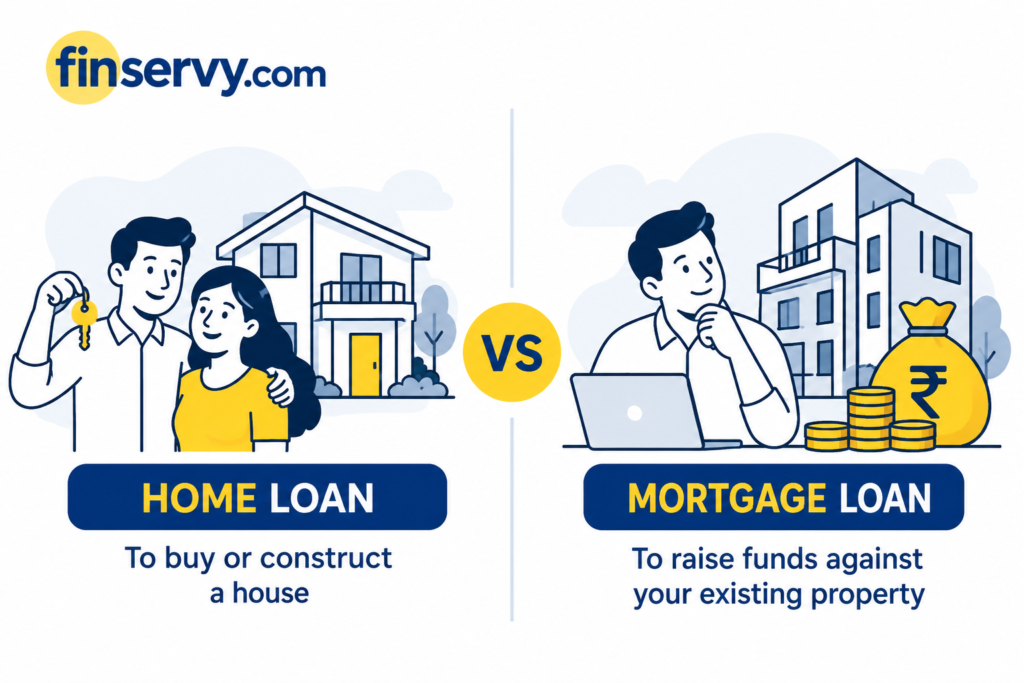
Home Loan vs Mortgage Loan: What Is the Difference in India?
Are you planning to buy a house, or do you need funds by using your existing property? Understanding the difference between a home loan and a mortgage loan can help you choose the right financing option.
Although both loans involve property and may require a mortgage as security, their purposes, eligibility requirements, interest rates, and repayment conditions can differ.
At Finservy, we help borrowers understand different loan options so they can make informed financial decisions. In this guide, let us explore the difference between a home loan and a mortgage loan in India.
What Is a Home Loan?
A home loan is a type of loan offered by banks and financial institutions to help eligible borrowers purchase or construct a residential property. Depending on the lender’s products, financing may also be available for certain home renovation or improvement purposes.
The property being purchased or constructed generally serves as security for the loan.
Key Features of a Home Loan
- Purpose: Buying or constructing a residential property.
- Loan amount: Depends on the property cost, income, repayment capacity, and lender policies.
- Repayment tenure: Can extend over several years, subject to the lender’s terms.
- Interest rate: Depends on the lender, loan product, borrower profile, and prevailing market conditions.
- Security: Usually a mortgage over the property being financed.
Example of a Home Loan
Suppose you want to purchase a flat in Hyderabad worth ₹75 lakh. You have ₹15 lakh available as your contribution and need financing for the remaining ₹60 lakh.
If you meet the lender’s eligibility requirements, you may apply for a home loan to finance the purchase.
What Is a Mortgage Loan?
In everyday Indian banking terminology, a mortgage loan commonly refers to a Loan Against Property (LAP). It allows eligible property owners to raise funds by mortgaging an existing residential or commercial property.
Unlike a standard home loan, the funds may be used for various permitted purposes, such as business expansion, education, or other eligible financial needs, depending on the lender’s policy.
Key Features of a Mortgage Loan
- Purpose: Raising funds against an eligible property.
- Loan amount: Depends on the property’s assessed value, income, repayment capacity, and lender policies.
- Repayment tenure: Varies by lender and loan product.
- Interest rate: Depends on the lender, property, borrower profile, and loan terms.
- Security: An eligible property owned by the borrower or otherwise acceptable to the lender.
Example of a Mortgage Loan
Suppose you already own a commercial property in Hyderabad valued at ₹1 crore. You need ₹30 lakh to expand your business.
Instead of selling your property, you may explore a Loan Against Property. If the lender approves your application, you can access funds by mortgaging the property while continuing to own it, subject to the loan agreement.
Home Loan vs Mortgage Loan: Key Differences
| Feature | Home Loan | Mortgage Loan / LAP |
|---|---|---|
| Main purpose | Purchase or construction of a home | Raise funds against an existing property |
| Property | Usually the property being purchased or constructed | Generally an already-owned eligible property |
| Use of funds | Restricted to the approved housing purpose | Broader permitted personal or business purposes |
| Loan amount | Based on property cost and repayment capacity | Based on property valuation and repayment capacity |
| Interest rate | Generally lower than LAP, but varies | Generally higher than a home loan, but varies |
| Repayment tenure | Often available for longer tenures | Depends on the lender and product |
| Tax treatment | Benefits may be available under applicable tax provisions | Depends on the use of funds and applicable tax rules |
| Security | Usually the property being financed | The property pledged for the loan |
Note: Interest rates, loan amounts, repayment tenures, and eligibility criteria vary across financial institutions. A home loan is also secured by a mortgage over the property being financed.
Can You Get a Mortgage Loan on an Existing Home?
Yes. If you own a residential property and meet the lender’s eligibility criteria, you may be able to obtain a Loan Against Property.
For example, you may explore this option if you need funds for:
- Business expansion or working capital, subject to lender policy.
- Education expenses.
- Certain medical or family expenses.
- Other permitted financial requirements.
The lender will typically assess the property’s legal ownership, market value, documentation, your income, existing liabilities, and repayment capacity.
Remember that your property is at risk if you fail to repay the loan according to the agreement.
Which Is Better: Home Loan or Mortgage Loan?
Neither option is universally better. The right choice depends on why you need the money.
Choose a home loan when:
- You plan to purchase a residential property.
- You need financing for an eligible home construction project.
- You want a loan designed specifically for housing.
Consider a mortgage loan when:
- You already own an eligible residential or commercial property.
- You need funds for a permitted purpose other than purchasing the property.
- You want to explore borrowing against your property’s value rather than selling it.
Before making a decision, compare the interest rate, processing fees, total repayment, loan tenure, prepayment conditions, and risks associated with the property.
Can You Transfer an Existing Home Loan to Another Bank?
Yes. If you already have a home loan, you may be eligible for a home loan balance transfer to another lender offering more suitable terms.
A balance transfer may help you explore a lower interest rate, a different repayment tenure, or other loan features. However, compare the total costs, including processing charges and any applicable fees, before switching.
If you have an existing Loan Against Property, some lenders also offer balance transfer options for eligible borrowers.
How Finservy Can Help
Choosing between a home loan and a mortgage loan can be confusing, particularly when different lenders offer different terms and eligibility requirements.
Finservy helps borrowers explore suitable financing options, including:
- Home loans for eligible property purchases and construction.
- Mortgage loans and Loan Against Property.
- Home loan balance transfer options.
- Mortgage loan balance transfer options, subject to lender availability.
- Loan eligibility guidance and documentation support.
Our aim is to help you understand your options and prepare for the loan application process. Final approval, interest rates, and loan terms are determined by the respective financial institution.
Frequently Asked Questions (FAQs)
1. Is a home loan the same as a mortgage loan?
No. A home loan is primarily intended to finance the purchase or construction of a home. A mortgage loan commonly refers to borrowing against an existing property, often through a Loan Against Property.
2. Can I use a mortgage loan for business purposes?
Depending on the lender’s policy, an eligible borrower may use a Loan Against Property for permitted business purposes. The lender will assess your financial position and property documents.
3. Which loan usually has a lower interest rate?
Home loans generally have lower interest rates than Loans Against Property, but actual rates depend on the lender, borrower profile, loan structure, and prevailing market conditions.
4. Can I get a mortgage loan on a residential property?
Yes. Eligible residential properties may be accepted as security for a Loan Against Property, subject to the lender’s valuation, legal checks, and other requirements.
5. Can I transfer my mortgage loan to another bank?
Some banks and financial institutions offer Loan Against Property balance transfers. Availability and eligibility depend on the lender and the existing loan.
6. Does a mortgage loan mean I lose ownership of my property?
No. Mortgaging a property does not ordinarily transfer its ownership to the lender. However, the property serves as security, and the lender may pursue recovery against it if the borrower defaults, subject to applicable law.
Final Thoughts
A home loan and a mortgage loan both help people access property-related financing, but they serve different financial needs.
If you are purchasing a house, a home loan may be the appropriate option. If you already own a property and need funds for an eligible purpose, a Loan Against Property may be worth exploring.
Understanding your requirements, comparing lenders, and reviewing the total cost of borrowing can help you make a more informed decision.
Need help exploring home loans or mortgage loans?
Visit Finservy.com to learn more about our loan assistance services and explore financing options that suit your requirements.
Disclaimer: This article is for general educational purposes only. Loan eligibility, interest rates, tax treatment, and approval are subject to lender policies and applicable laws. Finservy does not guarantee loan approval or any specific interest rate.